
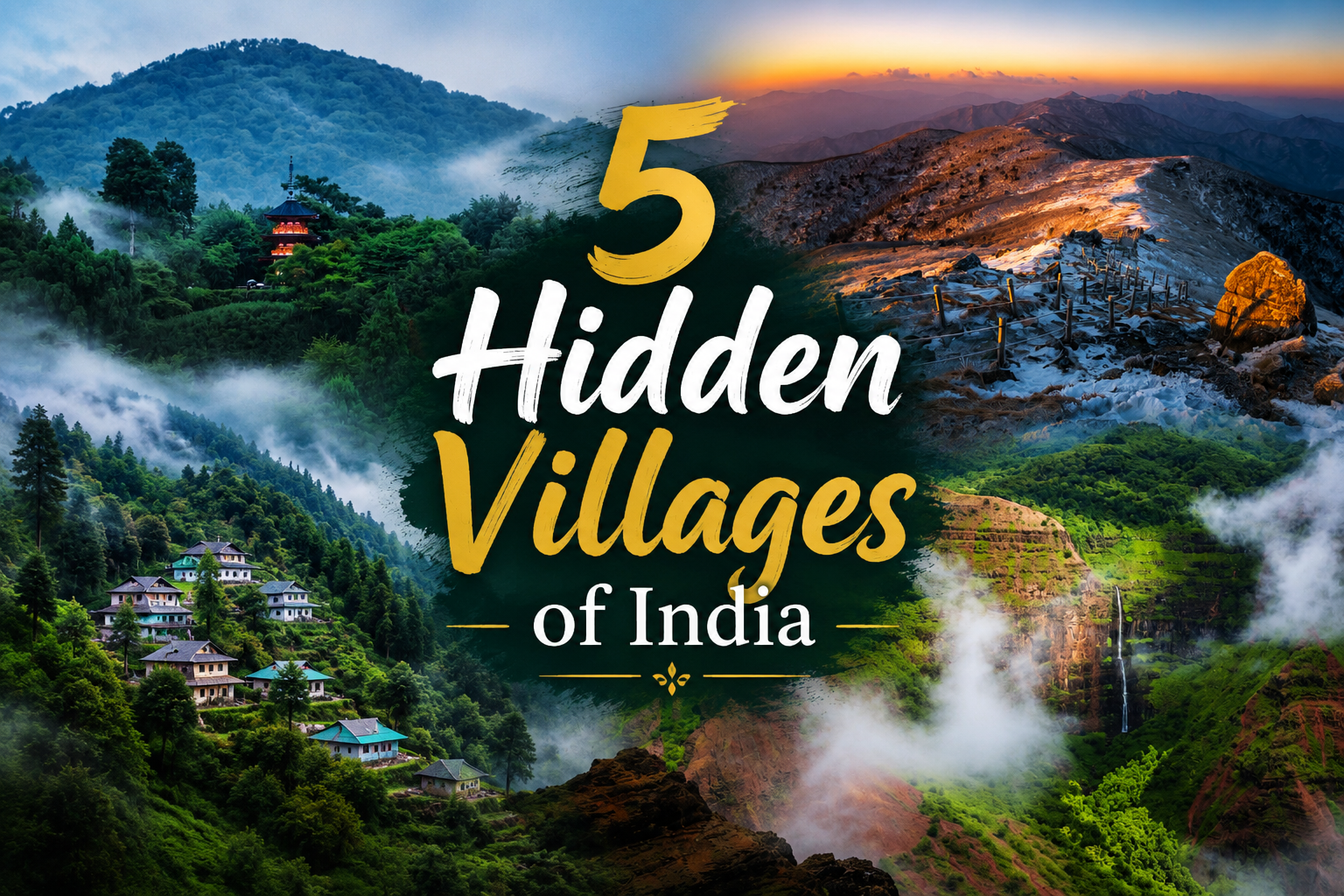
5 Hidden Villages of India You Didn’t Know Existed
India’s big-ticket destinations get all the postcards, but tucked away in its mountains and misty hills are villages so quiet and untouched that most travellers never hear their names. These are places where the air still smells like pine and woodsmoke, where the loudest sound is a prayer flag snapping in the wind, and where “nightlife” means a sky full of stars instead of a string of bars. If you’re chasing something slower, greener, and far less crowded than the usual India itinerary, these five hidden villages deserve a spot on your list.
1. Yuksom, Sikkim
Long before Gangtok became Sikkim’s busy capital, that title belonged to Yuksom, a small West Sikkim village where the kingdom’s first Chogyal (king) was crowned in 1642. The name itself means “meeting place of the three learned monks,” a nod to the trio of lamas who traveled from Tibet to anoint Sikkim’s first ruler. Today Yuksom is better known as the gateway to Mount Kanchenjunga and the starting point of the famous Goecha La trek, but the village itself is worth lingering in. Wander to the Norbugang coronation throne, still strung with fluttering prayer flags, walk up to the centuries-old Dubdi Monastery, or sit beside Kathok Lake, said to be blessed by the very monks who crowned the king. Surrounded by the Khangchendzonga National Park, Yuksom moves at the pace of a mountain village that has never tried to be anything else, which is exactly its charm.
2. Kibber, Himachal Pradesh
At over 4,200 metres in the cold desert of Spiti Valley, Kibber is one of the highest inhabited villages in the world with a motorable road connecting it to civilisation. The landscape here looks more like Tibet than the India most travellers picture: bare mountains, whitewashed monasteries, and a silence so complete you can hear your own footsteps. Kibber is the base for the Kibber Wildlife Sanctuary, home to the elusive snow leopard, ibex, and the Himalayan blue sheep, making it a favourite for wildlife photographers willing to brave sub-zero mornings. Thin air and clear skies also make it a stargazer’s paradise, with almost zero light pollution. Life in Kibber revolves around barley fields, Buddhist rituals, and a resilience that comes from surviving Himalayan winters year after year, offering visitors a rare, unfiltered look at high-altitude living.
3. Mawlynnong, Meghalaya
Mawlynnong in Meghalaya’s East Khasi Hills has earned a title few villages anywhere can claim: Asia’s Cleanest Village, a recognition it first received in 2003. There’s no municipal cleaning crew here; the discipline comes entirely from the community, with cone-shaped bamboo bins lining every path and children sweeping the lanes each morning before school. Homes are framed by flowers, walkways are spotless, and the entire village runs on the Khasi tribe’s matrilineal traditions, where lineage and inheritance pass through the women of the family. Beyond the famed cleanliness, Mawlynnong is home to a living root bridge, woven from rubber tree roots over generations, and a bamboo skywalk offering sweeping views toward the Bangladesh plains. It’s proof that a small community, working together, can build something the rest of the world simply comes to admire.
4. Ziro Valley, Arunachal Pradesh
Ringed by pine-covered hills and paddy fields, Ziro Valley is home to the Apatani tribe, known for a unique agricultural system that grows rice and fish together in the same flooded fields. It’s this ingenuity, along with the valley’s untouched natural beauty, that has put Ziro forward as a UNESCO World Heritage nominee. Older Apatani women here still carry facial tattoos and nose plugs, a striking tradition their ancestors adopted, as local lore goes, to protect the tribe’s women from being taken by rival groups. Ziro is best known outside the region for its annual music festival, but for most of the year it’s simply a peaceful valley of thatched-roof homes and terraced fields where visitors can slow down and watch village life unfold undisturbed.
5. Khonoma, Nagaland
About 20 kilometres from Kohima, Khonoma carries two very different legacies. In the late 19th century, it was a warrior village whose Angami Naga fighters held off British colonial forces in a series of fierce battles. Today, that same fighting spirit has been redirected entirely toward conservation, earning Khonoma the title of India’s first Green Village. The community banned hunting and logging, turned a chunk of forest into the Khonoma Nature Conservation and Tragopan Sanctuary to protect the endangered Blyth’s tragopan, and still farms its hillsides using a sustainable form of jhum cultivation. Wooden gates, old forts, and terraced rice fields give the village a lived-in, storied feel, and a walk through Khonoma is as much a lesson in environmental stewardship as it is a scenic escape.
Why These Villages Deserve Your Next Trip
What ties Yuksom, Kibber, Mawlynnong, Ziro, and Khonoma together isn’t geography, it’s spirit. Each of these villages has held onto something the rest of the world has largely lost: a genuine relationship between people, tradition, and land. There are no queues, no crowds, and no filters needed, just real places shaped by real communities.
If you’re tired of ticking off the same tourist circuit and craving something quieter, these hidden villages are where India still feels undiscovered. Pack light, keep an open mind, and let a mountain trail or a village lane lead the way.
A few things are worth keeping in mind before you go. Most of these villages sit at high altitude or in remote terrain, so build in extra travel days, carry warm layers even in summer, and check road and weather conditions before setting out. Homestays are usually the best, and often the only, way to stay, and they’re also the best way to support the community rather than bypass it. Move slowly, ask before photographing people or homes, and follow local customs, especially in places like Mawlynnong and Khonoma, where community discipline is central to what makes the village special in the first place. Responsible travel is what keeps these hidden corners of India worth discovering for the next traveller too.
Ready to explore India’s hidden corners? Plan your offbeat journey with KindQuest Travel at kindquesttravel.com.

