
Banaras – The City Your Soul Understands Before Your Words Do
There is a moment that happens to almost everyone who arrives in Banaras, usually within the first hour, often on a boat or in a lane too narrow for the words “lane” or “narrow” to do justice to. It’s the moment your mind is still trying to make sense of the marigolds, the ash, the bells, the cow ambling past a five-hundred-year-old temple wall, the boatman humming something older than the river itself — and somewhere underneath all that processing, something in you has already understood. Not intellectually. Not in a way you could explain to someone back home. Just understood, the way you understand warmth on your skin before you find the word “sun.”
Banaras doesn’t wait for your vocabulary to catch up. It rarely does.
What Makes Banaras Different From Every Other City on Earth?
Varanasi — called Banaras colloquially and Kashi in its oldest, most sacred breath — is widely considered one of the oldest continuously inhabited cities in the world, older than recorded memory in the way Indians often describe it: a place that didn’t begin so much as it was always already there. It sits on the western bank of the Ganga, sacred to Shiva, and carries the nickname “the City of Light,” not for its electricity but for the belief that liberation itself is lit here.
What sets it apart isn’t a single monument or a skyline. It’s that the sacred and the everyday refuse to separate. A man selling vegetables sets up shop ten feet from a thousand-year-old shrine. A wedding procession crosses paths with a funeral one. Nobody finds this strange, because in Banaras, nothing about life and the divine sharing the same footpath is strange at all.
The Ghats — Where a Thousand Prayers Meet the River Every Morning
The ghats are Banaras’s spine — some eighty-odd stone staircases descending into the Ganga, each with its own character, its own crowd, its own centuries. The real introduction to the city happens at dawn, on a wooden boat drifting past Assi Ghat toward Dashashwamedh, while the sky turns the colour of a struck match and the water turns the colour of the sky.
You’ll see priests under bamboo umbrellas already at work. Widows in white. Children swimming where their grandparents once swam. Old men doing yoga with the unhurried confidence of people who have nowhere else they’d rather be. The boatman’s oar barely disturbs the surface, as if even the water is asked to be reverent.
Ganga Aarti — Watching Faith Catch Fire at Dusk
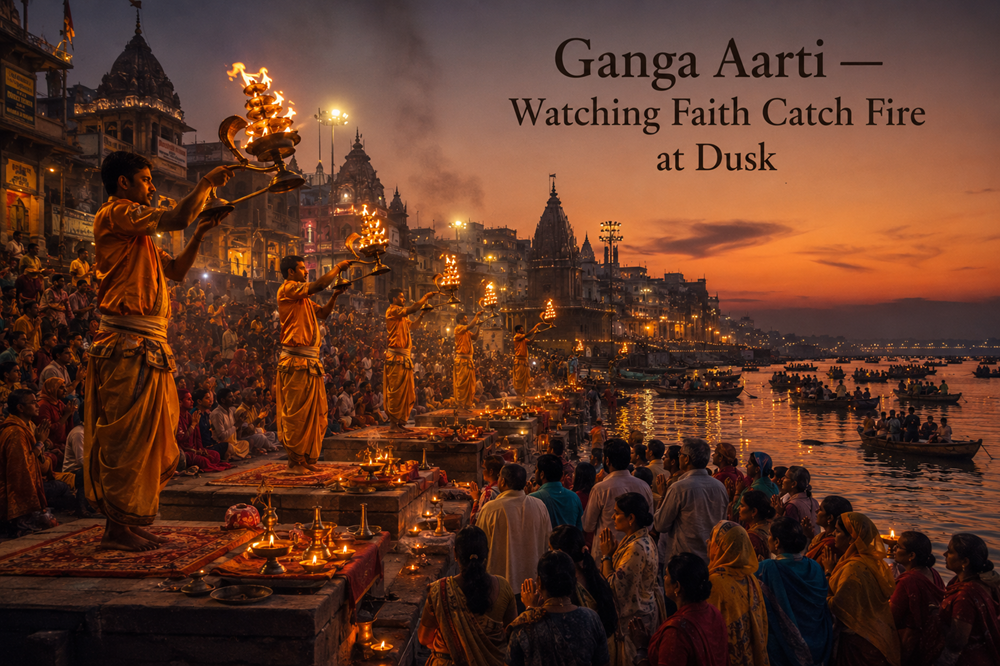
If the morning ghats are quiet devotion, the evening Ganga Aarti at Dashashwamedh Ghat is devotion as performance — and somehow that doesn’t make it any less moving. Young priests in saffron robes raise multi-tiered brass lamps in synchronized, circular motions, conch shells sound across the water, bells ring in overlapping rhythms, and hundreds of small diyas are released onto the river by visitors who came as tourists and are leaving, however briefly, as something closer to pilgrims.
It is loud, crowded, and unmistakably theatrical — and underneath the theatre, entirely sincere. Few cities manage that combination. Banaras does it nightly.
The Galis of Kashi — Where Getting Lost Is the Point
Step away from the river and Banaras shrinks into its galis — alleyways so tight that two people with shopping bags require negotiation to pass each other. This is old Kashi: silk looms still working behind shopfronts that sell the famous Banarasi sarees, shrines built into walls so casually you might walk past three before noticing one, the golden spire of the Kashi Vishwanath Temple rising above rooftops, paan shops where the folding of betel leaf is performed with the precision of a ritual because, in a way, it is one.
GPS gives up here, and that’s fine. The galis aren’t meant to be navigated efficiently. They’re meant to be wandered, the way you’d wander through someone’s memory.
A Banarasi Morning — Kachori, Lassi, and the Art of Slowness
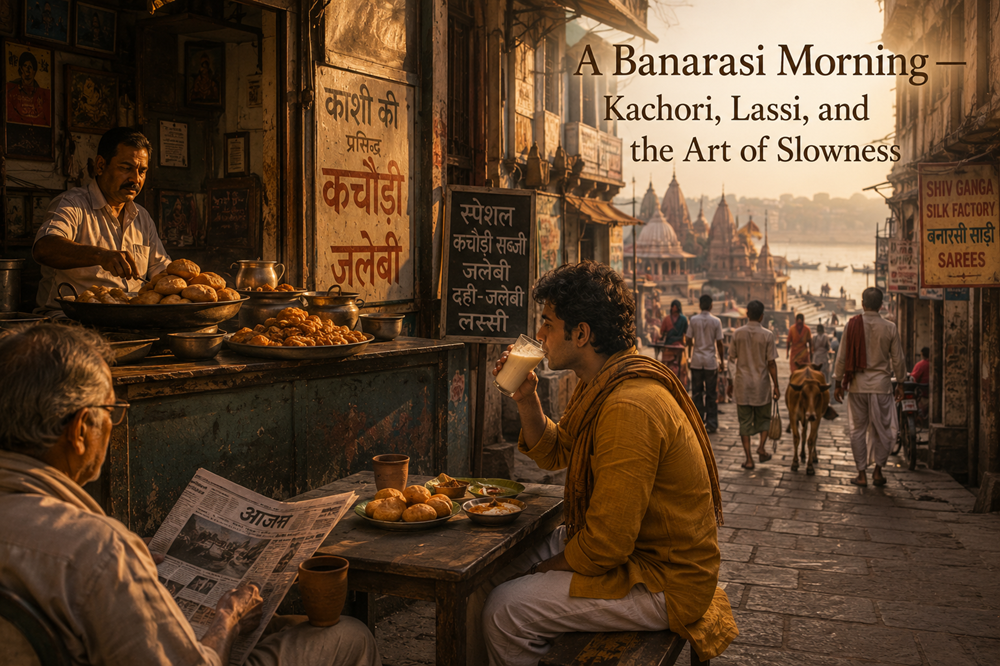
Banaras eats the way it prays: unhurried, communal, and slightly indulgent. Mornings mean kachori-sabzi from a stall that’s likely been frying the same recipe for three generations, eaten standing up off a leaf plate. There’s the ritual of the city’s famous lassi shops — thick, clay-cupped, sometimes piled absurdly high with malai and dry fruit — where you wait in a queue that moves slowly because nobody making your lassi is in a hurry, and neither, apparently, should you be.
Paan closes the meal, not as dessert but as punctuation — a small green parcel of betel leaf, areca nut, and sweet fillings that the city treats less as a snack and more as a sentence everyone agrees on finishing.
Where Life and Death Sit Side by Side
This is the part of Banaras that unsettles first-time visitors most, and the part many leave thinking about longest. At Manikarnika Ghat, cremation fires have burned continuously for centuries — not hidden away, but visible from the river, part of the city’s daily rhythm. Hindus believe dying in Kashi, or having one’s ashes scattered in the Ganga here, grants moksha — liberation from the cycle of rebirth.
What’s striking isn’t the presence of death. It’s the absence of fear around it. Banaras doesn’t treat death as a tragedy to be sanitized or a topic to be avoided. It treats it as a continuation, witnessed openly, mourned without spectacle, and folded into the same river where children swim and women wash clothes an hour later. Visitors are asked not to photograph the cremation ghats — a request worth honouring without hesitation. Some of what you see in Banaras isn’t meant to become content. It’s meant to become understanding.
Beyond the River — Sarnath, BHU, and the Sound of Banaras
A short drive from the ghats lies Sarnath, where the Buddha is believed to have given his first sermon after attaining enlightenment — a quieter, greener counterpoint to the intensity of the river. Closer to the city centre, Banaras Hindu University’s sprawling campus houses the New Vishwanath Temple and a more contemplative version of the city’s spirituality.
And then there’s the sound of Banaras itself — the city that gave classical Indian music its Banaras gharana, a tradition of tabla and vocal music that shaped generations of musicians, with the late shehnai maestro Bismillah Khan among its most celebrated sons. Evenings here aren’t complete without stumbling into a small classical recital happening somewhere, for no reason other than that someone felt like playing.
When Should You Go? Practical Notes for Visiting Banaras
October through March offers the most comfortable weather, with cool mornings ideal for the sunrise boat ride. If timing allows, Dev Deepawali — fifteen days after Diwali — turns every ghat into a field of lit diyas and is worth planning a trip around. Three to four days is enough to feel the city’s rhythm without rushing it; modest dress is appreciated near temples and ghats, mornings are best for the river, and evenings belong to the aarti and the galis. Bargaining is expected in the markets, and a local guide for the first day in the old city saves hours of pleasant but disorienting wandering.
Frequently Asked Questions About Visiting Banaras
Are Banaras, Varanasi, and Kashi the same place? Yes. Varanasi is the official name, Banaras the everyday colloquial name, and Kashi the older, more spiritually loaded name used in religious and literary contexts. Locals move between all three depending on the moment.
How many days should I spend in Banaras? Three to four days is a comfortable minimum — enough for a sunrise boat ride, the evening aarti, time in the old city lanes, and a half-day trip to Sarnath, without feeling rushed.
Is it okay to take photographs at the ghats? Most ghats welcome photography, especially during the Ganga Aarti. The exception is Manikarnika and Harishchandra, the cremation ghats — photography there is considered deeply disrespectful and should be avoided entirely.
What is the best time of day to experience Banaras? Dawn for the river and the boat ride, dusk for the Ganga Aarti. The city essentially offers two different personalities depending on whether the sun is rising or setting over the water.
Is Banaras safe for solo travelers, including women? Like any major Indian city, it’s generally safe with ordinary precautions — staying aware in crowded ghats and lanes, using registered transport at night, and dressing modestly near religious sites. Solo travelers, including women, visit regularly and safely.


Comments are closed