
5 Must-Visit Waterfalls in India: Nature's Most Breathtaking Cascades
By KindQuest Travel
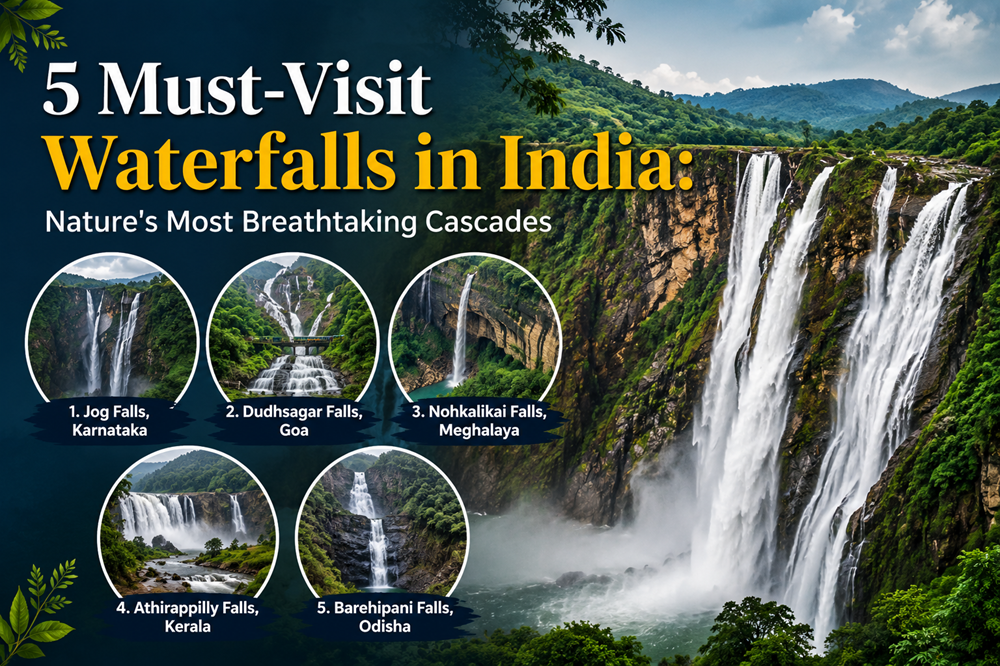
India's landscape hides some genuinely dramatic waterfalls, carved out by monsoon rivers cutting through forest, gorge and plateau. From the thundering curtains of Karnataka to the misty cliffs of Meghalaya, these five belong on any serious travel list.
1. Jog Falls, Karnataka
Formed by the Sharavathi River dropping roughly 253 metres across four distinct falls — Raja, Rani, Roarer and Rocket — Jog is one of India's tallest waterfalls. It's at its most powerful from July to September, when the swollen river turns the drop into a wall of white water and mist. A viewing gallery near Sagara town offers a wide vantage point, and trekkers can hike down to the base for a closer look.
2. Dudhsagar Falls, Goa
Set on the Mandovi River along the Goa-Karnataka border, Dudhsagar — "sea of milk" — earns its name from the frothy white water tumbling over four tiers into the forest below. It sits inside Bhagwan Mahavir Wildlife Sanctuary, with a railway bridge running right across its face, making it a favourite sight for train travellers on the Vasco-Castle Rock line. Jeep safaris through the sanctuary are the usual way to reach the base.
3. Nohkalikai Falls, Meghalaya
Near Cherrapunji, one of the wettest places on the planet, Nohkalikai is India's tallest plunge waterfall — a single, uninterrupted drop of about 340 metres into a striking turquoise pool. Since it's fed entirely by rainfall rather than a river, it's at its fullest right after heavy monsoon showers. A short walk from the parking area leads to a viewpoint over the falls and pool.
4. Athirappilly Falls, Kerala
On the Chalakudy River in the Sholayar forest range, Athirappilly is often called the "Niagara of India" for its wide, horseshoe-shaped curtain crashing nearly 24 metres into the gorge. It sits inside dense tropical forest that's also home to elephants and hornbills, and has appeared in numerous Indian films. A well-maintained viewing platform makes it accessible, and nearby Vazhachal Falls is easy to add to the same trip.
5. Barehipani Falls, Odisha
Inside Similipal National Park, Barehipani is a two-tiered waterfall and one of the tallest in India, with a total drop of around 399 metres. Because it sits inside a tiger reserve, visiting requires prior permits and is usually done as part of a jeep safari — adding a layer of adventure to the visit. The best views come from a designated watchtower, especially just after fresh rain.
Best Time to Visit
Most of these are at their fullest during and just after monsoon, roughly June to September, when rainfall-dependent falls like Nohkalikai and Barehipani hit peak flow. Trails get slippery in this season, so sturdy footwear and caution near viewpoints matter.
Whether it's the sheer height of Barehipani, the cinematic sweep of Athirappilly, or the misty grandeur of Jog Falls, each of these offers a different reason to plan a monsoon trip — pair the visit with a nearby wildlife sanctuary or hill town to round out a full itinerary.